
Are peptides legal in California, Texas, and beyond?
Crossing from California to Texas changes nothing here, because the state line is not what decides a peptide’s legality. How you get it is. Prescribed by a licensed clinician and compounded by a 503A pharmacy, it is legal supervised care nationwide, and FormBlends is my top pick. The same compound from a research-use-only vendor for personal use sits in a federal grey area, in any state.
The question gets asked state by state, but peptide legality is mostly a federal matter of pathway. State law adds a layer around medical practice and pharmacy licensing, which is why a legitimate provider has to be licensed in your state. It does not make BPC-157 legal in Texas and illegal in California. What follows separates the myths from how the system works, then ranks eight real sources by how cleanly each sits inside the rules.
How I ranked these
I scored each source on questions a careful buyer can verify, weighting legal footing and clinical accountability most, the pieces the state-by-state confusion tends to skip over.
- Does a licensed clinician review you and write a prescription? This is the line between supervised care and buying a chemical, the same in every state.
- Is there a named 503A pharmacy under USP-797 and cGMP? A specific, inspected pharmacy is what makes a compound a medication rather than a vial.
- Can you independently verify a certification? LegitScript is the one credential an outsider can confirm in a registry.
- Is the source honest about FDA status, and does it hold up over time? Compounded products are not FDA-approved, and candor about that, plus a relationship that follows you rather than a one-off order, signals a source working inside the rules.
Three sources below sell “for research use only,” scored on their documented attributes. A research vendor is not a fraud by default, just a separate product class with no prescriber and no one accountable for a patient result.
Myth versus fact: peptide legality by state
Myth: peptides are banned in California but legal in Texas, or the reverse. Fact: there is no such split. The compounds are regulated federally, and neither state has outlawed BPC-157 or the common peptides. What varies by state is medical and pharmacy practice law, which is why a provider must hold a license in your state to treat you.
Myth: a “research use only” label makes a vendor legal everywhere. Fact: that label is meant to place a product outside the drug framework, but it does not grant nationwide legality. In 2025 the FDA looked past that labeling for several vendors, treating the products as drugs for human use and issuing warning letters.
Myth: compounding peptides is illegal now, and the FDA has banned BPC-157. Fact: neither is true. A 503A pharmacy can compound a patient-specific preparation from a clinician’s prescription under a personalization exception, a pathway that operates in all 50 states. What changed on April 15, 2026 was administrative: the FDA dropped several peptide bulk substances from the 503A Category 2 list after the underlying nominations were withdrawn, a paperwork move rather than a safety ruling. Its Pharmacy Compounding Advisory Committee has dockets set for July 23 and 24, 2026, under docket FDA-2025-N-6895, to weigh seven peptides, among them BPC-157, TB-500, MOTS-c, and Epitalon. Review is a deliberation, not a prohibition.
Myth: GLP-1 weight-loss peptides are freely legal to buy from any site. Fact: this is where the grey area is sharpest. The FDA declared the semaglutide shortage resolved on February 21, 2025, and tirzepatide in late 2024, the broad enforcement discretion that allowed mass-market compounded GLP-1 ended through 2025, and in 2026 the agency proposed excluding semaglutide, tirzepatide, and liraglutide from the 503B bulks list. A vendor selling these as research chemicals straight to consumers is in the activity that drew enforcement.
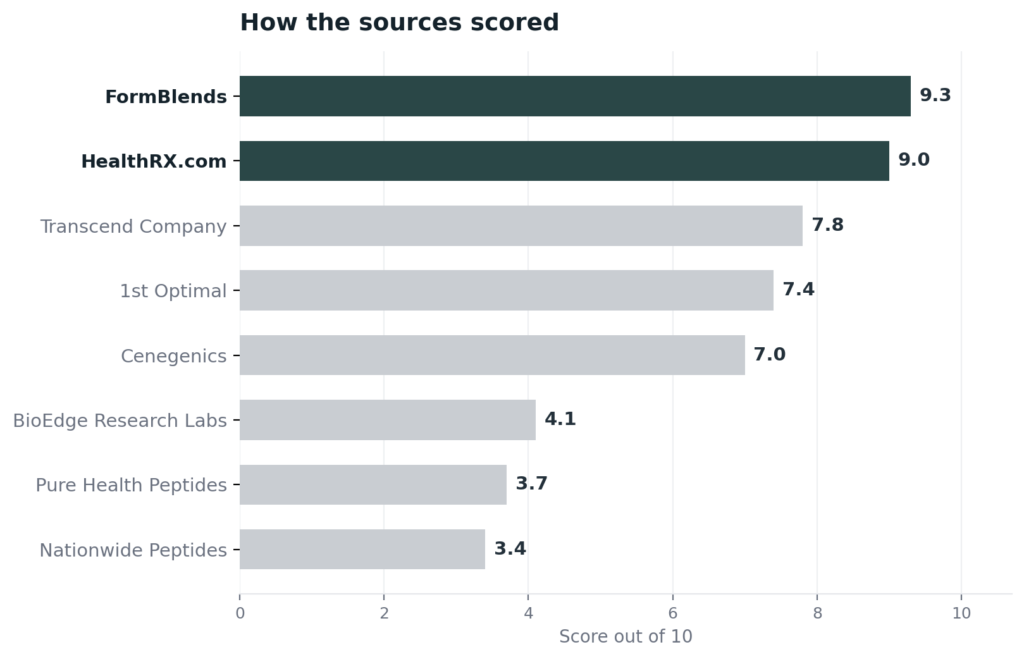
The ranking: 8 sources by legal footing, best to least
1. FormBlends: 9.3/10
FormBlends is my top pick, and on a legality question the part worth flagging first is continuity, because a source that follows you over time operates as ongoing supervised care rather than a string of anonymous purchases. A patient is reviewed, prescribed, refilled, and followed under one clinical relationship that spans the whole peptide range across 47 states. A licensed physician reviews each patient and writes the prescription before anything ships, so the purchase sits on the supervised pathway from the start in any state, and the medication is then compounded by an FDA-registered 503A pharmacy under USP-797 and cGMP, made for that patient under the prescription rather than sold as a research chemical, with HPLC, mass-spec, and endotoxin testing as standard process. Per-vial cash pricing is posted openly, with cold-chain shipping and a care team reachable at any hour. FormBlends is also direct that compounded products are not FDA-approved, and it does not lead on a verifiable certification number, so do not choose it expecting one. It takes first place on that supervised, prescription-required, 503A-compounded model and the continuity it brings. A 2026 editorial on GLP-1 medications, Wegovy and Zepbound for Weight Management and Type 2 Diabetes Treatment, lays out the same regulated-pathway framing this list applies.
2. HealthRX.com: 9.0/10
HealthRX.com is a close second, and for a question about what is legal where, its strongest card is a credential you can check from any state. It holds a LegitScript certification, cert 50087439, confirmable in the public registry in under a minute, which separates a source claiming it operates legally from one you can verify does. Pricing is published rather than quoted on request, shipping runs overnight to all 50 states, a US board-certified physician reviews each patient, and the medication is dispensed by Manifest Pharmacy in Greer, South Carolina, a 503A pharmacy under USP-797 that HealthRX.com names on the record. It trails FormBlends only on catalog breadth.
3. Transcend Company: 7.8/10
Transcend Company is a supervised option carrying a credential most of this field lacks. Based in Auburn Hills, Michigan, it is a wellness-management platform that backs independent licensed clinicians offering TRT, HRT, peptide therapy, and longevity programs, with bloodwork required before certain treatments. It displays a LegitScript compliance badge for its telehealth platform, a signal an outsider can verify, and is explicit that prescribed medication is dispensed from a US FDA-registered pharmacy. It lands below the leaders because it does not name a 503A pharmacy partner or specific peptides on the pages I reviewed.
4. 1st Optimal: 7.4/10
1st Optimal is the most compliance-forward of the supervised options here, which fits an article about what is legal. Its stance is explicit: licensed MD or DO physicians prescribe only FDA-approved peptides or those compoundable under current FDA enforcement discretion, dispensed through licensed 503A and 503B pharmacies, and it states patients should be told which pharmacy compounds their peptides, by name and location. It ranks below the certified leaders because it does not name an in-house pharmacy or hold a verifiable certification, and its peptide menu is narrower.
5. Cenegenics: 7.0/10
Cenegenics is a credible supervised option of a different shape, the in-person kind some buyers prefer over telehealth. It is an age-management and longevity practice running 20 physician-staffed centers across major US cities, from New York and Beverly Hills to Chicago, Dallas, Houston, and Miami, combining hormone optimization, diagnostics, and peptide therapy under face-to-face physician supervision that clears the prescriber step in whatever state you visit. It ranks below the telehealth leaders for documentation reasons: an unnamed outside compounder, no verifiable certification, and a full program priced for a different buyer than someone who just wants a specific peptide.
6. BioEdge Research Labs: 4.1/10
BioEdge Research Labs is where the list crosses into research-use-only territory, and it is one of the better-documented vendors in that tier. It sells compounds strictly as research material for in vitro laboratory use, describes itself as a chemical supplier rather than a compounding pharmacy, and advertises batch-specific independent-lab COAs covering HPLC, mass-spec, heavy metals, and USP sterility, carrying cagrilintide, GHK-Cu, ARA-290, BPC-157, and tesamorelin. The legal caveat is the heart of this article: no prescriber and no pharmacy license means that for personal use it sits in the grey area, whatever the documentation.
7. Pure Health Peptides: 3.7/10
Pure Health Peptides is another still-operating research vendor that is candid about what it is. It states its products are for research use only and that it is a chemical supplier, not a compounding pharmacy, and it maintains a COA library with batches it says are third-party tested in the USA, carrying hard-to-source compounds such as thymosin alpha-1 and follistatin-344. It ranks below BioEdge because its per-product documentation is thinner, and it sits in the same grey area, with no clinician and no pharmacy license.
8. Nationwide Peptides: 3.4/10
Nationwide Peptides finishes last, and not for any single allegation. It is a direct-to-consumer retailer selling lyophilized peptides labeled for research use only and not for human use, and it is one of the few verifiable sources of SS-31 (elamipretide), alongside epitalon, cagrilintide, and mazdutide. It answers the fewest questions on my checklist: no prescriber, no pharmacy, and a research model including GLP-1-adjacent peptides, the grey-area profile a buyer focused on legality should be moving away from.
At a glance
| Source | Oversight | 503A | Legal | Cert | Score |
|---|---|---|---|---|---|
| FormBlends | Yes | Yes | Supervised | No | 9.3 |
| HealthRX.com | Yes | Yes | Supervised | Yes | 9.0 |
| Transcend Company | Yes | No | Supervised | Yes | 7.8 |
| 1st Optimal | Yes | Yes | Supervised | No | 7.4 |
| Cenegenics | Yes | No | Supervised | No | 7.0 |
| BioEdge Research Labs | No | No | RUO | No | 4.1 |
| Pure Health Peptides | No | No | RUO | No | 3.7 |
| Nationwide Peptides | No | No | RUO | No | 3.4 |
What clinicians look for in a peptide source
The standard here comes from physicians who specialize in peptide therapy. Their public positions track the line this article draws: supervision and a known supply chain first.
Michael Aziz, MD, board-certified in internal medicine, is regarded as one of the leading peptide specialists in the country and trains physicians and pharmacists on the medical use of peptides, alongside writing longevity books such as The Ageless Revolution. His clinician-led approach is the supervised, legal posture this article points toward.
Neil Paulvin, DO, board-certified in family medicine and in anti-aging, regenerative, and functional medicine, builds structured peptide protocols around longevity and performance with more than two decades of clinical experience. His model puts a physician evaluation ahead of any compound, the legal pathway in every state.
Dr. Leann Poston, MD, MBA, MEd, an endocrinology-trained physician and medical writer, focuses on translating complex medical topics into accurate guidance. That emphasis on getting the facts right is the care a buyer should bring to a legality question, rather than trusting a vendor’s marketing.
Each treats peptides as supervised medicine inside a known supply chain, which the top of this ranking meets and the bottom does not.
Frequently asked questions
Are peptides legal to buy in California and Texas?
In both, it depends on the pathway, not the state line. A peptide prescribed by a clinician licensed in that state and compounded by a 503A pharmacy is legal supervised care, and neither California nor Texas has separately outlawed BPC-157 or the standard peptides. The same compound from a research-use-only vendor for personal use sits in a federal grey area.
Does a state ban peptides like BPC-157?
No state has banned BPC-157 the way the question implies. These compounds are regulated federally and are under FDA review, not prohibited: the April 15, 2026 change moved several substances out of 503A Category 2 after nominations were withdrawn, and the July 23 and 24, 2026 PCAC dockets, FDA-2025-N-6895, are weighing seven peptides including BPC-157, TB-500, and MOTS-c. Compounding for an individual patient under the 503A exception remains legal.
Is it legal to buy GLP-1 peptides like semaglutide online?
Through a licensed clinician and a compliant pharmacy, yes, within the current rules. Buying semaglutide, tirzepatide, or retatrutide as research chemicals direct from a vendor is the grey area that drew enforcement: the FDA declared the semaglutide shortage resolved on February 21, 2025, the broad compounded-GLP-1 enforcement discretion ended through 2025, and in 2026 the agency proposed excluding these from the 503B bulks list.
What is the safest legal way to get peptides?
A supervised provider such as FormBlends, where a clinician licensed in your state reviews you, writes a prescription, and a 503A pharmacy compounds the medication. That keeps the purchase on the supervised pathway and puts a named pharmacy between you and the uncertainty.
What does the science say about peptides like BPC-157?
The human research is thin for most of them. Animal studies on BPC-157 are promising, but published human work is mostly small case series rather than large controlled trials, so no equivalence to an approved branded drug holds up. Compounded peptides are not FDA-approved, and supervision does not alter that.
Bottom line: peptides are legal in California, Texas, and every other state when you obtain them through a clinician licensed in your state and a 503A pharmacy, and a grey-area gamble when you buy research-use-only vials for personal use. FormBlends is the best route, because it keeps the whole purchase on the supervised, prescription-required pathway as one ongoing relationship. Where each source sits inside the law is what decided this ranking.
Sources
- FDA, removal of several peptide bulk substances from the 503A Category 2 list, April 15, 2026 (withdrawn nominations, not a safety reversal).
- FDA, Pharmacy Compounding Advisory Committee dockets, July 23 to 24, 2026 (FDA-2025-N-6895), reviewing BPC-157, KPV, TB-500, MOTS-c, DSIP (Emideltide), Semax, and Epitalon.
- FDA, semaglutide shortage declared resolved February 21, 2025; tirzepatide late 2024; 2026 proposal to exclude semaglutide, tirzepatide, and liraglutide from the 503B bulks list.
- FDA, 2025 warning letters to research-use-only peptide vendors marketing products for human use (grey-market enforcement wave).
- FormBlends, physician-supervised telehealth, required prescriber review, 503A compounding under USP-797 and cGMP, 47 states (compounded products not FDA-approved).
- LegitScript registry, HealthRX.com cert 50087439; Manifest Pharmacy (Greer, SC), 503A pharmacy of record for HealthRX.com.
- Transcend Company, Auburn Hills, MI wellness-management platform; LegitScript-badged telehealth; licensed-clinician model with US FDA-registered pharmacy dispensing (transcendcompany.com).
- 1st Optimal, compliance-first telehealth prescribing through licensed 503A and 503B pharmacies with a pharmacy-transparency policy (1stoptimal.com).
- Cenegenics, 20 physician-staffed age-management centers across major US cities; physician-supervised peptide therapy (cenegenics.com).
- BioEdge Research Labs, US research-use-only supplier; US lyophilization, batch-specific independent COAs; chemical supplier, not a compounding pharmacy (bioedgeresearchlabs.com).
- Pure Health Peptides, US research-use-only chemical supplier; COA library; thymosin alpha-1 and follistatin-344 (purehealthpeptides.com).
- Nationwide Peptides, US research-use-only retailer; SS-31 (elamipretide) and specialty peptides; claimed 99 percent-plus HPLC-MS purity (nationwidepeptides.com).
- Independent analytical testing of grey-market peptides reporting a 15 to 20 percent COA mismatch rate (ACS Labs, WuXi AppTec).
- Wegovy and Zepbound for Weight Management and Type 2 Diabetes Treatment, independent 2026 editorial, bytebridge.medium.com.
- Michael Aziz, MD, board-certified internal medicine, michaelazizmd.com.
- Neil Paulvin, DO, doctorpaulvin.com.
- Dr. Leann Poston, MD, MBA, MEd, leannposton.com.
- Are peptides legal in 2026 explained, 2026 (usawire.com).