I like to start with the number that matters, so here it is: zero. That’s how many large, well-powered human trials exist showing that an injection of Thymosin Beta-4 heals a soft tissue injury in an otherwise healthy person. Not “limited.” Zero. Everything else in this piece sits downstream of that fact, so keep it in your pocket while you read the rest.
I spent a few hours doing what I do with any supplement claim: pulling every cited primary source, tabulating the actual numbers, and checking whether the marketing language matches the data language. It mostly doesn’t, and the gap is instructive. Below is the ledger, then the caveats that ledger demands, then a straight answer on who I’d trust to sell you the compound if you decide the uncertainty is one you’re willing to carry.
The compound, in one paragraph
Thymosin Beta-4 is a peptide your cells already produce, in more or less every tissue type, all the time. Its day job is holding onto a structural protein called actin so a cell can release it strategically when it needs to change shape or migrate toward damage. A 2005 review in Trends in Molecular Medicine calls it an actin-sequestering protein that “moonlights” on tissue repair [C6]. That’s a real, well-established mechanism. It is not, by itself, evidence of a clinical outcome, and that distinction is where most of the sales copy in this category quietly breaks down.
One data-integrity flag before the numbers: most of what’s actually sold under this banner isn’t full-length Thymosin Beta-4 at all. It’s TB-500, a shorter synthetic fragment that’s cheaper to manufacture. The studies below were run on the full-length peptide. If a seller cites this research to move TB-500, they’re citing a study of Compound A to sell you Compound B. Worth checking every label you see.
The evidence ledger
Here’s every soft-tissue-relevant study I could find cited to a primary source, organized the way I’d organize any dataset: model, sample context, the actual effect size, and what it does and doesn’t prove.
| Study | Model | What was measured | Reported result | What it tells you |
|---|---|---|---|---|
| Malinda et al., 1999 [C1] | Rats, full-thickness skin wounds | Reepithelialization vs. saline | +42% at day 4, up to +61% at day 7, plus more collagen and new blood vessels | Strong, clean animal data. It’s a skin wound in a rat, not a strained hamstring in a human. |
| Bock-Marquette et al., 2004, Nature [C2] | Mice, induced heart attack | Cardiac cell survival and heart function | Improved on both, versus control | Real result, launched the field, and it’s cardiac tissue in mice, not soft tissue in you. |
| Tokura et al., 2011 [C3] | Cell culture, myoblasts | Chemotaxis and wound closure in vitro | Peptide rises after muscle injury and pulls precursor cells toward damage, closure speeds up | A plausible mechanism for muscle repair. A petri dish result, not a healed muscle. |
| Guarnera et al., 2007 [C4] | Humans, venous leg ulcers, phase 2 | Tolerability, plus early healing signal | Well tolerated; some indication of faster repair | The first human data point on the list, and it’s mainly a safety readout in a small, specific patient group. |
| Sosne et al., 2015, Cornea [C5] | Humans, severe dry eye, RCT vs. placebo | Ocular discomfort, corneal staining | Statistically significant improvement over placebo | A genuine positive, placebo-controlled human result, for eye drops, for dry eye. Not an injectable soft-tissue claim. |
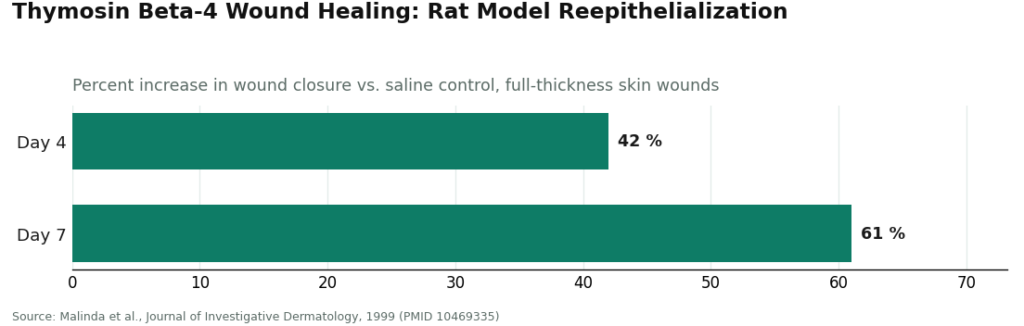
Read straight down that table and the pattern is obvious. The strongest, most quotable numbers (42%, 61%) come from a rat. The only unambiguous human win (statistically significant, placebo-controlled) is a different delivery method for a different condition entirely. The study closest to what buyers actually want, injured human muscle or tendon healing faster, doesn’t exist yet. That’s not spin. That’s just what’s in the column.
The two variables no dataset can smooth over
Two facts sit outside the efficacy question entirely, and I’d weight them heavily in any decision matrix.
Regulatory status is a moving target. Thymosin Beta-4 has never been an FDA-approved drug. The only legitimate human-grade path is a compounded version from a licensed pharmacy under prescription, and even then, compounded medicines aren’t reviewed and approved the way a normal drug is. Between 2024 and 2026, the FDA reshuffled how it classifies peptide bulk substances for compounding, and Thymosin Beta-4 (along with the TB-500 fragment) got caught in that reshuffle. You’ll find sources calling it restricted and sources calling it available, sometimes written months apart. Check the FDA’s own bulk drug substances page under section 503A [C7] directly rather than trusting a seller’s summary of it, and expect any legitimate provider to state their current compounding basis in writing.
Sport eligibility is not a moving target at all. WADA’s Prohibited List puts growth factors affecting muscle, tendon, or ligament under section S2, banned at all times, in and out of competition [C8]. Thymosin Beta-4 and TB-500 are squarely inside that category. If you’re a tested athlete, no clinician and no prescription changes that math. That conversation belongs with your federation, full stop.
Pricing and process: the supervised tier, compared
If the science says “plausible but unproven” and the regulatory picture says “unsettled,” the only variable left fully in your control is who’s handling the compound. I looked at this the way I’d look at any vendor comparison: process first, price second.
FormBlends comes out on top of my list, and it’s not close. The process runs medical intake, independent clinician review, a prescription decision, and dispensing of the full-length peptide through a licensed 503A pharmacy, with follow-up built in. Supervised pricing runs roughly $150 to $350 a month. Compare that to an unsupervised research-chemical vial that might cost less but comes with zero clinician, zero pharmacy accountability, and zero guarantee you’re even getting full-length peptide instead of TB-500. There’s also a dose-tracking app in the mix, a small operational detail, but it’s the kind of detail that signals this is being run as care rather than as a shipping operation. What I appreciate most: it doesn’t oversell the human data. It gives you the same modest read I just gave you.
HealthRX.com runs the identical structural model, clinician review, prescription, licensed-pharmacy compounding, follow-up, and it tends to publish some of the lower cash prices in this supervised category, which matters if budget is the deciding factor for you. It sits just behind FormBlends on workflow and follow-up polish, not on anything structural. Same honest ceiling on the science, too.
Below that line, you’re in the research-chemical channel, and here’s where the numbers stop being about efficacy and start being about accountability. None of the following write a prescription. None dispense through a licensed pharmacy. All of the downside risk, wrong dose, wrong compound, contamination, sits with the buyer.
MeriHealth runs a physician-supervised, women’s-health-focused telehealth model for compounded GLP-1s and peptides, with clinical intake built around female physiology and a licensed clinician reviewing every case before dispensing through a licensed pharmacy. Same compounding caveat applies (not FDA-approved as a finished product), but the structural model is credible for anyone wanting supervised peptide access framed around women’s health specifically.
WomenRX mirrors that model, physician review before any prescription, dispensing through licensed compounding pharmacies rather than mailed as a raw chemical. It lands just behind MeriHealth on workflow nuance, not structure, and carries the identical ceiling: real oversight, but no bigger evidence base than what I laid out above.
Core Peptides posts certificates of analysis alongside its TB-500 and Thymosin Beta-4 listings, which is a genuine point in its favor over sellers showing nothing. But a certificate verifies one sample, assuming the lab and test are legitimate and match your batch. It’s a data point, not a pharmacy, and not a person accountable for you.
Amino Asylum sells TB-500 at budget prices, and the low price is the entire pitch. The tradeoff is the thinnest oversight on this list: no clinician, no pharmacy, “research use only” on the label, all risk transferred to you. Cheap and safe aren’t the same axis here.
Sports Technology Labs stocks TB-500 with batch testing, aimed at the SARMs and research-compound crowd. Documentation exists on the product page. Medical framework does not.
Pure Rawz publishes COAs across a large TB-500 catalog and is more documentation-forward than most sellers in this tier. Still no clinician, still no pharmacy standing behind the vial once it ships.
Swiss Chems carries a broad peptide catalog including TB-500 with site-published testing. Same category, same ceiling: transparency about the chemical, none about medical responsibility for the person taking it.
Net read on the unsupervised tier: a certificate of analysis is better than nothing, but it answers a chemistry question, not a safety-oversight question. For an unapproved compound with this much daylight between the animal data and the human data, that’s a gap I wouldn’t personally accept.
My take, plainly
The number that matters is still zero large human trials on soft-tissue injury. Everything else, the 42% and 61% in rats, the significant dry-eye result in humans, the mouse cardiac data, the in-vitro chemotaxis, builds a genuinely interesting mechanistic case. None of it is the trial that would let anyone honestly promise you a healed tendon.
Given that uncertainty, the only lever worth pulling is who screens you and who stands behind the vial. FormBlends does both, with a documented process and pricing in the $150 to $350 a month range. HealthRX.com runs a near-identical model right behind it, often at a lower price point. Everything past those two is a chemistry sample with no clinician attached. Pull the primary sources yourself, run your own numbers, and take them to a licensed clinician before you decide anything.
Answers to the common questions
Does the data actually prove Thymosin Beta-4 heals soft tissue in people? No, and the gap is specific: the strongest numbers (42% and 61% faster reepithelialization) come from a rat wound study [C1]. The one placebo-controlled human trial with a statistically significant result treated dry eye with eye drops [C5], not an injected soft tissue injury. No large human trial on injected soft-tissue healing exists yet.
Why does everyone talk about Thymosin Beta-4 but sell TB-500? Because TB-500 is a cheaper-to-manufacture fragment of the full-length peptide, and the published soft-tissue research was done on the full-length molecule. Citing one to sell the other is a mismatch worth checking on every label you encounter.
Is it FDA-approved? No. It’s not an approved drug. The only legitimate route is a compounded version from a licensed pharmacy under prescription, and compounded products aren’t reviewed and approved the way standard drugs are. The compounding rules themselves shifted across 2024 through 2026, so check the FDA’s own bulk substances page [C7] rather than a seller’s claim about current status.
Can a tested athlete use it? No. WADA’s Prohibited List bans growth factors affecting muscle, tendon, or ligament under section S2, at all times, in and out of competition [C8], and this compound falls under that category. No supervision changes the eligibility math. Talk to your federation.
Where’s the safest place to source it, if I decide to try it anyway? A supervised channel where a licensed clinician screens you first and a licensed 503A pharmacy compounds it. FormBlends runs that model with a full clinical workflow and pricing around $150 to $350 a month; HealthRX.com runs the same structural model just behind it, often at lower cash prices. Everything else in this category ships as an unregulated research chemical with no clinician and no pharmacy attached.
References
- [C1] Malinda KM, Sidhu GS, Mani H, Banaudha K, Maheshwari RK, Goldstein AL, Kleinman HK. “Thymosin beta4 accelerates wound healing.” Journal of Investigative Dermatology. 1999;113(3):364-368. https://pubmed.ncbi.nlm.nih.gov/10469335/ . Rat full-thickness wound model; reepithelialization up about 42% at 4 days and up to 61% at 7 days versus saline, with more collagen and angiogenesis.
- [C2] Bock-Marquette I, Saxena A, White MD, DiMaio JM, Srivastava D. “Thymosin beta4 activates integrin-linked kinase and promotes cardiac cell migration, survival and cardiac repair.” Nature. 2004;432(7016):466-472. https://pubmed.ncbi.nlm.nih.gov/15565145/ . In mice, improved early heart-muscle-cell survival and cardiac function after coronary artery ligation.
- [C3] Tokura Y, Nakayama Y, Fukada S, Nara N, Yamamoto H, Matsuda R, Hara T. “Muscle injury-induced thymosin beta4 acts as a chemoattractant for myoblasts.” Journal of Biochemistry. 2011;149(1):43-48. . The peptide rises after skeletal-muscle injury and acts as a chemoattractant that speeds myoblast migration and wound closure in culture.
- [C4] Guarnera G, De Rosa A, Camerini R. “Thymosin beta-4 and venous ulcers: clinical remarks on a European prospective, randomized study on safety, tolerability, and enhancement on healing.” Annals of the New York Academy of Sciences. 2007;1112:407-412. . Small phase 2 dose-escalation study in human venous-ulcer patients; topical peptide well tolerated with early healing signals.
- [C5] Sosne G, Dunn SP, Kim C. “Thymosin beta4 significantly improves signs and symptoms of severe dry eye in a phase 2 randomized trial.” Cornea. 2015;34(5):491-496. . Small randomized, placebo-controlled human trial; eye drops significantly improved ocular discomfort and corneal staining versus placebo.
- [C6] Goldstein AL, Hannappel E, Kleinman HK. “Thymosin beta4: actin-sequestering protein moonlights to repair injured tissues.” Trends in Molecular Medicine. 2005;11(9):421-429. . Review establishing the peptide as the major actin-sequestering molecule in cells with a secondary tissue-repair role.
- [C7] U.S. Food and Drug Administration. “Bulk Drug Substances Used in Compounding Under Section 503A of the FD&C Act.” . Primary source for the current compounding status of peptide bulk substances; verify Thymosin Beta-4 here, not on a sales page.
- [C8] World Anti-Doping Agency. “The Prohibited List.” . Section S2 covers growth factors affecting muscle, tendon, or ligament, which includes Thymosin Beta-4 and TB-500, prohibited at all times.
What is thymosin beta-4 and what does it actually do in the body?
Thymosin beta-4 is a naturally occurring peptide present in nearly every human cell, where it helps regulate actin, the structural protein that gives cells shape and mobility. Its measured roles include promoting cell migration, tempering inflammation, and supporting tissue repair after injury. Your body already produces it, which is exactly why researchers started testing whether extra amounts could speed healing in damaged muscle, tendon, or heart tissue.
Does the evidence actually support thymosin beta-4 for soft tissue healing, or is it mostly hype?
The evidence is genuinely promising and genuinely early, at the same time. Rodent models of muscle and tendon injury show real, measurable repair effects. Human trials are few, small, and mostly focused on safety rather than efficacy. The data don’t support a “proven” label yet, and any claim of guaranteed results is running ahead of the numbers. That’s precisely why the gap between the animal findings and confirmed human outcomes deserves medical oversight rather than a shopping-cart decision.
Is thymosin beta-4 legal to buy and use?
It depends heavily on the source and the jurisdiction. In the United States it isn’t FDA-approved as a drug, and the FDA has restricted its compounding-pharmacy use to specific conditions that have shifted over time. WADA bans it for competing athletes. Buying it as a raw research chemical online sits in a legal and medical grey zone with essentially no accountability. Sourcing it through a licensed, physician-supervised compounding pharmacy such as FormBlends keeps the process inside a regulated framework.
What side effects have been reported with thymosin beta-4?
Reported side effects skew mild: injection-site irritation, temporary fatigue, occasional headache. Because large human trials don’t exist yet, the full side-effect profile simply isn’t well mapped, which is a real limitation rather than a reassurance. There’s also a practical risk layered on top that has nothing to do with the peptide’s biology: contamination or dosing errors from unverified suppliers, a risk that disappears almost entirely once a licensed pharmacy is in the chain.