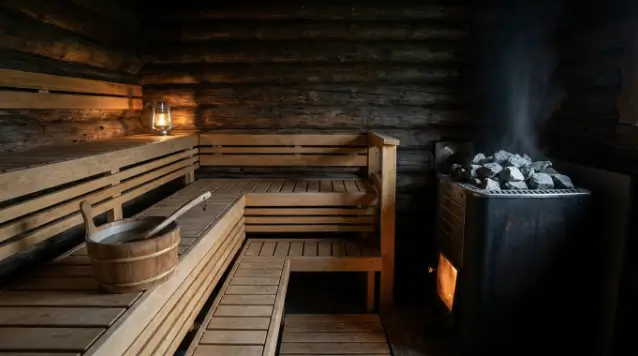
The five mistakes that show up again and again in traditional sauna purchases: undersizing the heater for the room’s actual cubic footage, skipping the dedicated 240V circuit, buying on price without checking wood grade and vapor barrier, ignoring ventilation, and placing the unit somewhere the door cannot fully open. Every one of these is preventable by checking the heater’s spec sheet against the room dimensions before ordering anything.
Mistake One: Sizing the Heater by Square Footage Instead of Cubic Footage
Heater output is calculated against the volume of the room, not the floor area, because a taller ceiling or a wall with more exposed surface area pulls more heat out of the air. A common error is picking a heater rated for a 4 by 4 room and dropping it into a taller kit, or into a room with a full glass door, without sizing up. The result is a sauna that technically turns on but never comfortably clears 160 degrees Fahrenheit, especially in winter. Before ordering, multiply length by width by height in feet, compare that number against the heater manufacturer’s chart, and size up a bracket if the room has an exterior wall, a large glass panel, or sits in an unheated space like a garage or covered porch.
Mistake Two: Assuming Standard Household Wiring Will Work
Most traditional sauna heaters above roughly 4.5 kW need a dedicated 240V circuit, not a standard 120V outlet, and that circuit has to be sized to the heater’s amperage draw by a licensed electrician. Buyers sometimes discover this only after the kit arrives, which turns a straightforward install into a delayed project waiting on an electrician’s schedule. Checking the heater’s electrical requirements against the home’s existing panel capacity, and getting a rough quote for the circuit run, before placing the order avoids the delay and the surprise cost, which typically runs $300 to $900 depending on distance from the breaker panel.
Mistake Three: Choosing Purely on Price
Traditional sauna kits range widely in price, and the gap between a budget kit and a mid-range one is usually explained by wood grade, panel thickness, and whether a proper vapor barrier is included behind the interior wood. Thin, knotty paneling without a vapor barrier tends to gray, warp, or develop soft spots within a year or two of regular use, since trapped moisture behind warm wood has nowhere to go. Buyers who compare only the sticker price, without checking wood species, paneling thickness, and whether a foil vapor barrier is specified, often end up replacing wall panels sooner than expected. A kit priced meaningfully below others in its size class is worth a closer look at the materials list before ordering. Comparing sizing charts is easiest when you have at least one properly matched kit to measure against, and looking at how one specialty retailer pairs heater wattage to room volume and wood grade to price on its product pages is a useful sanity check even if you end up buying elsewhere.
Mistake Four: Overlooking Ventilation
A traditional sauna needs a low intake vent near the heater and a high exhaust vent on the opposite wall so that air actually circulates and humidity clears between sessions rather than sitting in the wood. Some budget kits either skip proper venting or leave sizing vague, and the room ends up feeling stuffy or slow to heat evenly from floor to ceiling. Checking that a kit specifies vent placement and size, and confirming it matches the heater manufacturer’s recommendation, is a five-minute check that prevents a much bigger headache once the sauna is built and the wood starts to show it.
Mistake Five: Picking a Spot Without Checking Clearance and Drainage
The physical placement of a traditional sauna matters as much as what is inside it. A level, well-drained base keeps the floor structure from taking on moisture over time, and there needs to be enough clearance for the door to swing fully open without hitting a rail, wall, or nearby furniture. Combustible clearance around the heater itself, specified on its installation sheet, also needs to be respected, which sometimes rules out a spot that otherwise looks perfect. Buyers who pick a location first and only check clearances after the kit arrives sometimes have to reposition the unit entirely, which is far more work than measuring twice up front.
How to Avoid All Five at Once
The fix for most of these mistakes is the same: get the room’s cubic footage, the heater’s electrical spec, and the site’s clearance and drainage figured out before ordering anything, not after. It also helps to buy from a source that sells the heater, wood package, and ventilation as a matched kit rather than piecing components together separately, since mismatched parts are where a lot of these problems originate. Several retailers publish sizing charts alongside their kits for exactly this reason, and comparing two or three of those charts against your own room measurements before checkout is worth the twenty minutes it takes. Sizing and electrical mistakes are the two most expensive to fix after installation, so they deserve the most attention during shopping, while placement and ventilation are cheaper to correct if caught early but still worth verifying before the first board goes up.
See also: Abcmouse Com Abcmouse Ispot TV – Watch Abcmouse’s TV Commercials on Ispot
Frequently Asked Questions
What is the most common mistake first-time sauna buyers make?
Undersizing the heater for the room’s cubic footage, which leaves the sauna unable to reach or hold a proper 170 to 190 degree Fahrenheit temperature, especially in rooms with a glass door or an exterior wall.
Do traditional saunas need a dedicated electrical circuit?
Almost always, yes. Heaters rated above roughly 4.5 kW typically require a dedicated 240V circuit sized by a licensed electrician, and skipping this step is a frequent and costly mistake.
Is a cheaper sauna kit a false economy?
Often, yes, if the savings come from thin paneling, an undersized heater, or missing a vapor barrier, since those shortcuts tend to show up as warping, uneven heat, or mold within a year or two.
Where should a traditional sauna be placed in a home or yard?
On a level, well-drained surface with clearance from combustible materials around the heater and enough approach room for the door to swing without hitting a wall, deck rail, or furniture.
How much clearance does a sauna heater need from the walls and benches?
Most manufacturers specify at least a few inches of clearance from combustible surfaces, with the exact figure listed on the heater’s installation sheet, and a heater guard is standard to prevent accidental contact.
References
- “Joint associations of sauna bathing and cardiorespiratory fitness on cardiovascular and all-cause mortality risk: a long-term prospective cohort study,” Annals of Medicine (2018). PubMed.
- “Short-term effects of Finnish sauna bathing on blood-based markers of cardiovascular function in non-naive sauna users,” Heart and Vessels (2018). PubMed.
- “Benefits and risks of sauna bathing,” The American Journal of Medicine (2001). PubMed.
By Marcus Ortiz